
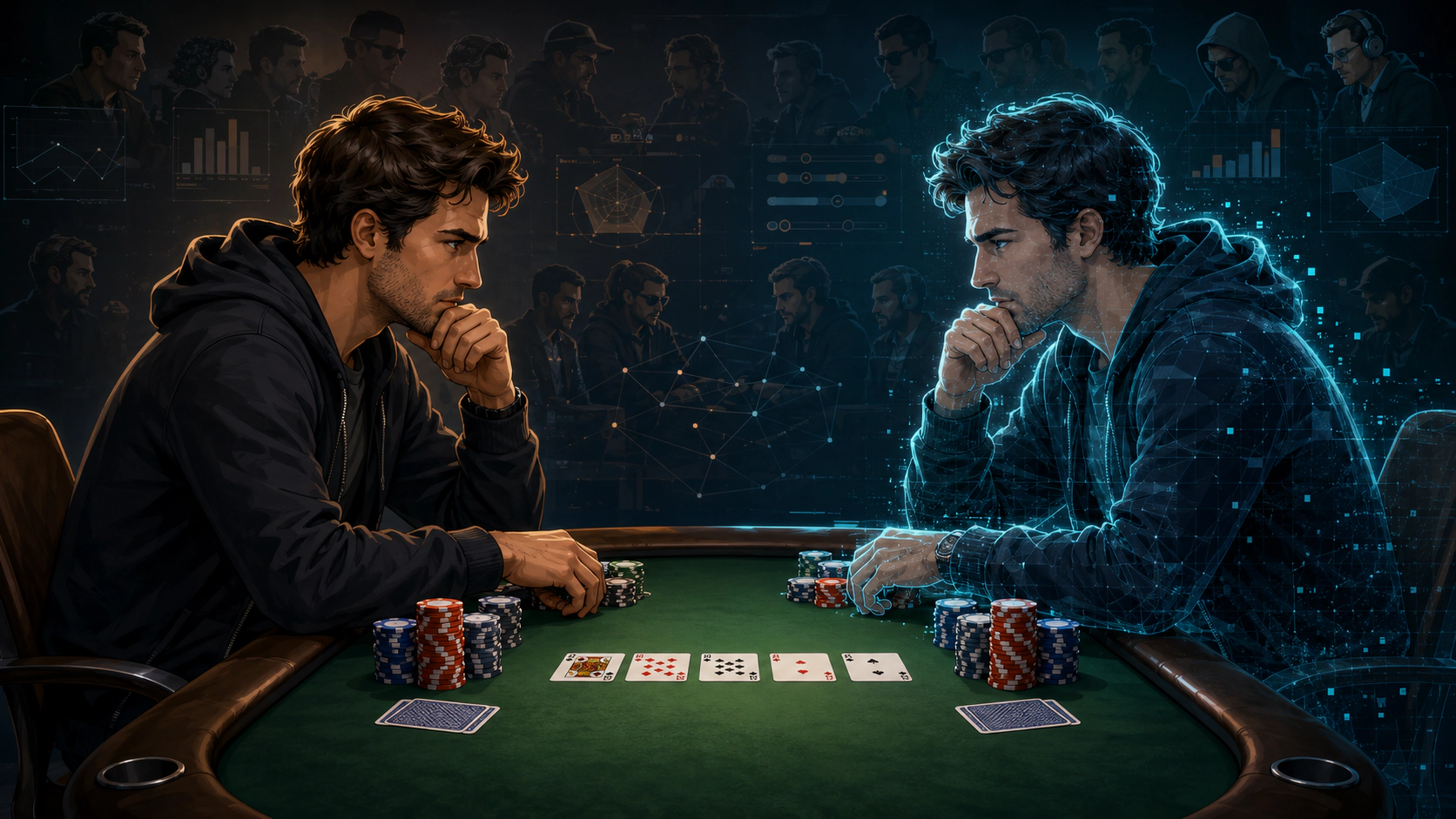
Now that we’ve shared the full simulation results, the obvious next question is: How did we build the 2026 WSOP Main Event bots to play like real people?
Related: See our complete 2026 WSOP Main Event simulation results and Steve Blay’s official prediction
People often ask me:
“How can a computer possibly predict how nine humans are going to play poker?”
It’s a fair question—and it gets to the heart of how you build a poker bot that plays like a real person.
The short answer is: I’ve been building poker bots for more than 15 years, and at this point I’ve probably spent more time thinking about computerized poker personalities than just about anyone on the planet.
The Goal Isn’t Perfect Poker
Advanced Poker Training now has more than 8,000 unique bots, and I built their personalities myself.
Some are designed to play like broad player types—the fearless maniac, the cautious nit. Others are modeled after real players I’ve known over the years.
The goal has never been to make bots that play “perfect” poker.
The goal is to make them play human poker.
More Than 40 Behavioral Characteristics
How do you make a bot feel human?
That’s where things get interesting.
I won’t reveal all of the knobs and dials—those are trade secrets—but each bot has more than 40 different behavioral characteristics that can be adjusted.
How does this player react to ICM—or Independent Chip Model— pressure? How reluctant are they to put their tournament life at risk? Which hands will they use to steal the blinds? How stubborn are they after getting called?
There are even seven separate configuration settings just for continuation betting, allowing a bot to behave very differently depending on position, board texture, and previous action.
The result isn’t a solver.
It’s a personality.
How We Built the 2026 WSOP Main Event Bots
Is it scientific? Not entirely.
Is there science behind it? Absolutely.
To build the 2026 WSOP Main Event bots, we used every meaningful piece of information available to us.
We don’t have every hand these nine players have ever played, but we do have meaningful information.
We know their backgrounds, their experience, their personalities from interviews, their professions, how they talk about poker, and we have hand histories that reveal tendencies.
None of those pieces tells the whole story by itself.
Together, though, they paint a surprisingly detailed picture of how each player is likely to approach the biggest final table of their life.
Think of It Like Election Forecasting
If that sounds a little far-fetched, think about election forecasting.
Pollsters don’t interview every voter in America. Instead, they combine demographics, historical trends, economic indicators, and even social media sentiment to build predictive models.
Those models are far from perfect, but they’re often surprisingly accurate.
Building poker bots isn’t all that different.
You’re taking incomplete information and using it to build the best predictive model you can.
Recreating the Real WSOP Final Table
Once the 2026 WSOP Main Event bots were built, the fun began.
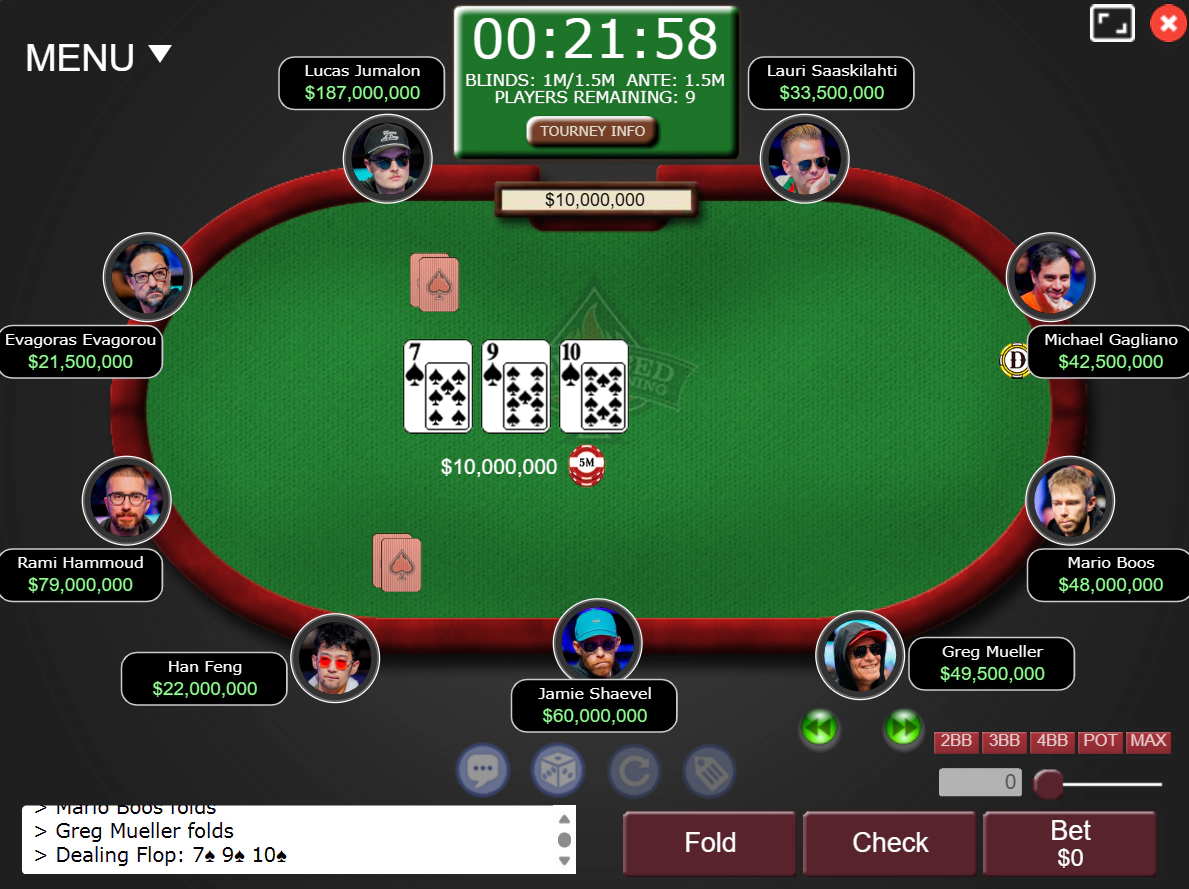
I seated each bot according to the actual WSOP seat draw, gave each one its real starting chip stack, set the blinds to 1,000,000/1,500,000 with a 1,500,000 big blind ante, and started the clock with 56 minutes and 40 seconds remaining in the level—exactly where the real final table resumes.
Then I simply let them play until someone had every chip in play.
Then I did it again.
And again.
And again.
One million times.
How Fast Can a Poker Bot Play?
At first glance, that sounds like a project that should take years.
It would—if humans were playing.
Fortunately, computers don’t stop to stack chips or stare dramatically across the table before making a river decision. The bots play at blistering speed.
I even simulate the passage of tournament time by advancing the clock after every hand.
A routine preflop steal might consume only about 30 seconds of tournament time, while a long, multi-street battle can burn several minutes.
Even with all of that, an entire WSOP Main Event final-table simulation—from nine players down to a champion—takes less than one second on modern hardware.
What Can One Million Simulations Tell Us?
A simulation cannot know exactly what a human player will do when the lights come on and the biggest title in poker is on the line.
Players can prepare differently, change strategies, react emotionally, or simply catch better cards than the model expects.
But one run is not the point.
By playing the same final table one million times, we can look beyond any single lucky river card and see the larger patterns:
Which players win most often? Which stacks are most vulnerable? Which playing styles perform best under the actual final-table conditions?
That doesn’t make the prediction certain.
It makes it informed.
The Technology Behind Advanced Poker Training
The same basic idea powers the human-like opponents inside Advanced Poker Training.
Instead of practicing against one generic opponent or a single “perfect” strategy, APT members can train against thousands of different poker personalities—each with its own tendencies, strengths, weaknesses, and reactions to pressure.
That variety is what makes practice feel more like real poker.
Because real poker isn’t played against a solver.
It’s played against people.
Ready to Train Against Human-Like Poker Opponents?
Practice against thousands of opponents with different playing styles, tendencies, strengths, and weaknesses.
