

Anyone who has tried to improve their poker game over the past decade has faced the same debate: GTO vs exploitative poker strategy?
It’s one of the most common questions recreational and improving players ask, and it’s usually framed as an either/or choice. Solver purists on one side, old-school intuition players on the other, and a lot of confused players in the middle wondering which camp they’re supposed to join.
Here’s the good news: it’s the wrong question. The best players in the world don’t choose between GTO and exploitative play. They use both, and by the end of this article you’ll understand exactly how, and which one you should focus on first.
What Is GTO Poker?
GTO stands for Game Theory Optimal. In simple terms, a GTO strategy is a mathematically balanced way of playing that cannot be exploited by your opponents, no matter what they do.
Let’s look at it like a game of rock-paper-scissors. If you use each option exactly a third of the time, completely at random, nobody will be able to beat you in the long run. Sure, they might take the odd game off you here and there, but over time your results even out no matter what strategy they employ. That’s an unexploitable, balanced strategy.
GTO works the same in poker, but with just a vast amount of complexity. A GTO poker strategy bluffs at the perfect frequency, value bets at the perfect frequency and defends against aggressive moves at the perfect frequency. Opponents can’t profit by adjusting against you. If they call too much, your value betting prints money. If they start folding more, your bluffs start printing money. The balance protects you.
Modern GTO poker solvers, the powerful pieces of software that solve the math behind this strategy, have transformed how the game is studied. When you hear players talk about “solver approved” plays or “GTO lines”, they’re referring to the output of these tools.
What GTO Is Not
A common misunderstanding is that GTO means you play like that poker software, or like a robot, or there’s one “correct” answer to every poker scenario. None of these are true.
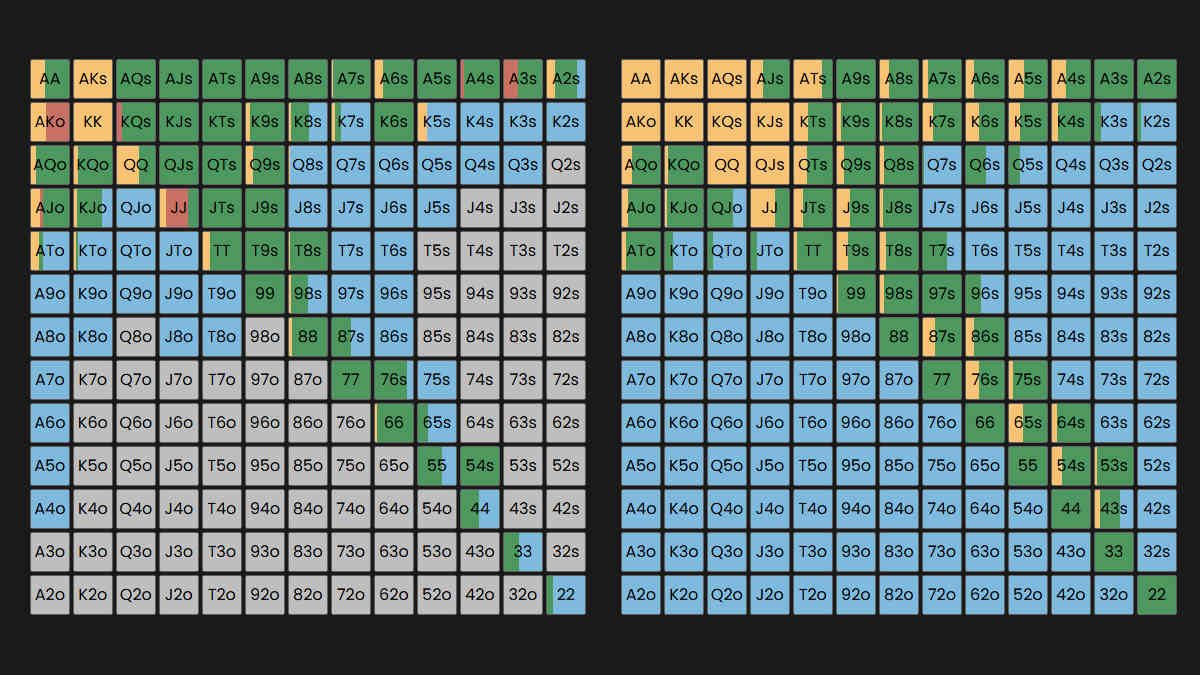
Look at GTO like a framework. The GTO solver tells us to use mixed strategies, meaning the same hand in the same spot might be a bet 70% of the time and a check 30% of the time. Nobody remembers these perfectly across the entire poker decision tree, and nobody needs to.
What studying GTO really teaches you is the underlying logic and math behind the game: which hands are good bluffs, which board textures affect ranges, what bet sizes work best, and what a balanced strategy looks like.
What Is Exploitative Poker?
Exploitative poker is the art of deviating from that balance, to take maximum advantage of the opponent you are facing in any given hand.
If GTO is the defensive fortress, exploitative play is the sword. And here’s the key insight: against opponents who make mistakes, exploitative play makes more money than GTO. Not slightly more. Often dramatically more.
Some classic examples:
- Your opponent folds too often to river bets. The GTO response is to bluff at a balanced frequency. The exploitative response is to bluff relentlessly, because they’re folding way more than they should.
- Your opponent never folds an overpair. GTO says to bluff-raise the turn at some frequency. Exploitative play says never bluff them, and value bet your two-pair and better value mercilessly instead.
- Your opponent limps every hand and calls every raise. No solver output is needed here. You simply value bet them into oblivion and stop bluffing entirely.
Exploitative play requires observation, attention and reads. It also needs courage, as you will make plays that the computer would not agree with. But when you are right about your opponents, you will be laughing all the way to the bank.
The GTO/Exploitative Poker Catch-22
There’s a trade-off, and it’s an important one. Every time you deviate from balance to exploit someone, you become exploitable yourself.
If you never bluff the river because your opponent never folds, an observant player can start folding everything but the nuts against your river bets. If you bluff constantly against a nit, a smart opponent might notice and start calling you down light.
Against weak opposition, this rarely matters, because they aren’t paying attention and won’t adjust. Against strong opposition, it matters a great deal. This is exactly why the answer to “GTO or exploitative?” depends on context.
GTO vs Exploitative: The Real Answer
Here’s the framework that top players and coaches actually use: GTO is your foundation, exploitative play is your in-game adjustment.
You start from a balanced baseline. Then, as you gather information about your opponents, you deviate deliberately and consciously to exploit the specific mistakes you observe. When you don’t have information, or when you’re up against strong players, you lean back towards balance.
Think of it like this:
- No reads? Play closer to GTO. Against unknown opponents, a solid balanced strategy guarantees you’re not the one being exploited.
- Clear reads? Exploit them. The moment you identify a leak, folding too much, calling too much, under-bluffing, over-bluffing, you deviate to punish it.
- Tough opponents? Return to balance. Against players capable of noticing and counter-adjusting, the safety of balanced play becomes valuable again.
The reason GTO comes first is because this should form your baseline poker strategy. What hands to open with, what your c-betting strategy looks like, how you defend from the big-blind and so on. You cannot exploit what you don’t understand.
Knowing what balanced poker looks like is what allows you to recognize when an opponent is deviating heavily from it, and how you adjust thereafter. A player who has not studied a balanced strategy doesn’t actually know when their opponent is folding too much, because they have no baseline for folding themselves.
In other words: you learn GTO so you know exactly how to break the rules.
Is GTO Worth It for Low Stakes?
This deserves its own section, because it’s one of the most searched questions on this topic, and the honest answer is more nuanced than most articles admit.
In low stakes cash games and tournaments, your opponents will be making drastic mistakes. They will be limping way too much, calling too much, they will never fold a draw, they will bet obscene sizes with strength, they cannot fold top pair or an overpair. Against a player pool like this, good exploitative poker will absolutely dominate compared to someone trying to play a GTO strategy. Full stop.
So is studying GTO a waste of time for low stakes players? No, and here’s why.
First, the foundation argument applies at every level. Low stakes players who understand balanced strategy exploit their opponents more effectively, not less, because they can identify mistakes accurately instead of guessing what is bad and good.
Second, you don’t stay at low stakes forever. If you’re improving, and if you’re reading this you presumably want to, the balanced fundamentals you build now are what allow you to move up. One day you will want to move from $1/$3 to $2/$5, and those games will have competent regs.
Third, GTO study fixes your own leaks. Most low stakes players lose money not because they fail to exploit others, but because they’re wildly exploitable themselves. They call too much, bluff at terrible frequencies, and don’t understand which hands to defend. GTO study is the fastest way to plug those leaks.
The practical advice for low stakes players: learn GTO fundamentals, preflop ranges, basic bet sizing logic, which hands make natural bluffs, but don’t obsess over solver-perfect frequencies. Spend the majority of your energy applying simple, powerful exploits against the obvious mistakes your opponents make every session.
How This Applies to Tournament Players
For MTT players, the GTO vs exploitative question comes with an extra wrinkle: tournaments constantly force you into situations where stack sizes, antes and pay jumps change what “correct” play looks like.
Short stack play, ICM pressure near the bubble, and final table dynamics all have strong theoretical foundations that are absolutely worth studying. At the same time, tournament fields, especially at low and mid stakes, are full of recreational players making exploitable mistakes, playing far too tight or loose near the bubble, or playing incredibly loose in the early stages.
The same framework applies: build the balanced foundation so you know what correct play looks like at each stack depth, then adjust aggressively based on the players at your table. Tournament players who can do both are the ones who go deep consistently rather than occasionally.
How to Actually Build Both Skills
Understanding GTO is one thing. Training it into your game is another. Here’s the uncomfortable truth: reading articles and watching training videos, while useful, doesn’t build the pattern recognition that playing does. Poker is a skill, and skills are built through reps like the gym.
The problem is that getting meaningful reps at the table is slow and expensive. You might see a tricky river spot once a session, and when you get it wrong, it costs you real money and you often don’t even find out it was wrong.
This is exactly the problem Advanced Poker Training was built to solve. APT lets you play hundreds of hands per hour against realistic AI opponents, each with genuine playing styles and tendencies, so you can:
- Build your GTO foundation by practicing sound, balanced poker against tough opponents and getting instant feedback on your decisions
- Sharpen your exploitative instincts by playing against opponents with realistic leaks, loose callers, tight folders, aggressive maniacs, and learning to identify and punish their mistakes
- Get advice as you play from APT’s built-in advisors, so you understand not just what the right play was, but why
It’s the difference between reading about swimming and getting in the pool. You can drill specific situations, replay hands, track your progress over time, and compress months of live experience into weeks of focused practice.
Ready to train both sides of your game? Start getting your poker reps in with APT free here
